
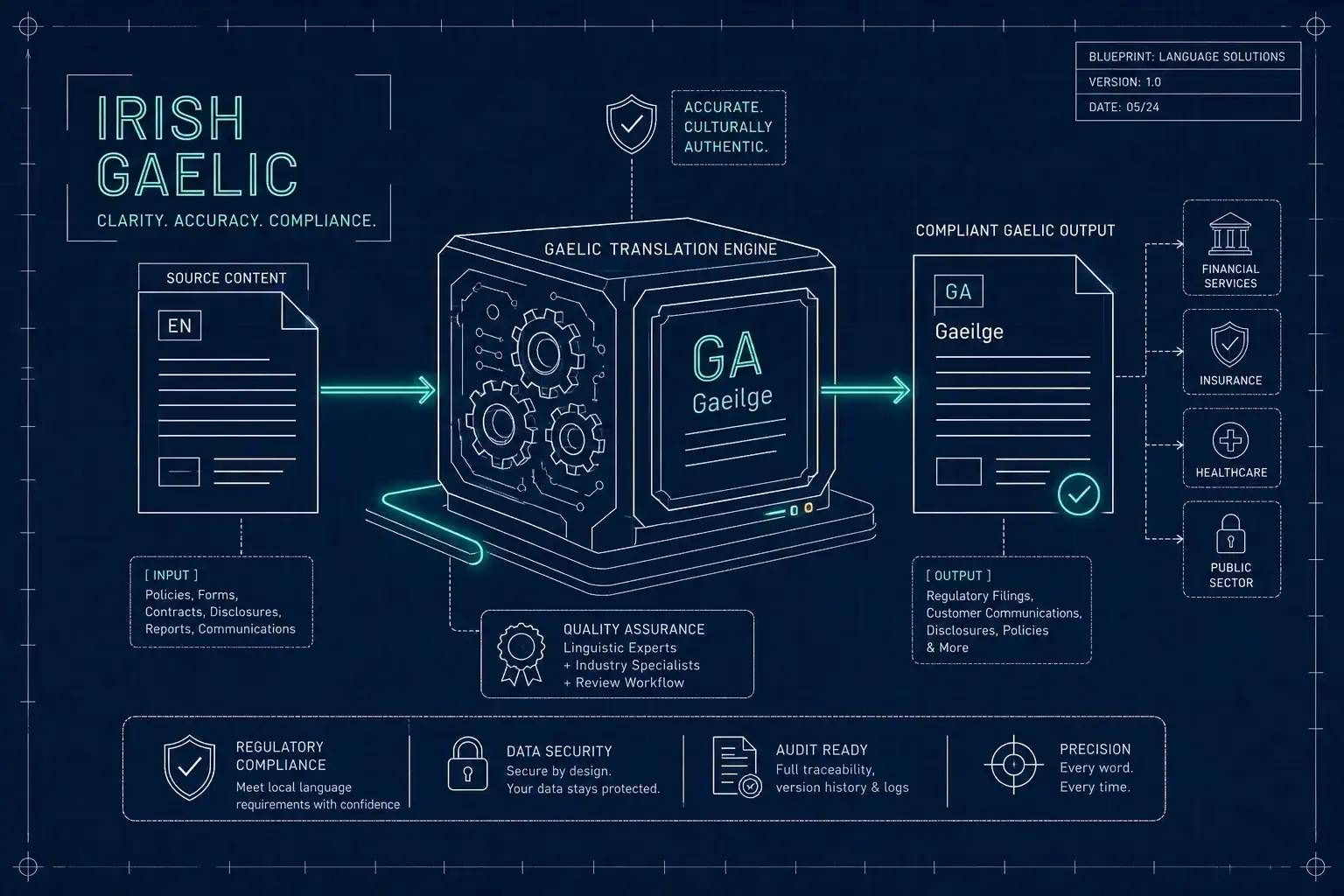
Irish (Gaeilge) holds co-official status in Ireland and is one of the EU’s official languages, yet it remains one of the most under-resourced languages in regulated translation workflows relative to major European counterparts. Businesses that serve Irish-speaking populations, or submit documents to Irish authorities, often discover too late that their approach does not meet the standard required. At TranslationsInLondon, we handle Irish Gaelic translations regularly for law firms, pharmaceutical companies, and immigration specialists, and the same problems surface repeatedly: machine-translated output submitted to UKVI, clinical instruments sent to a regulatory reviewer without a linguistic validation report, or marketing content written in Ulster Irish for an audience in Connacht. This article explains the use cases that genuinely require certified Irish Gaelic translations, why machine translation is a liability in regulated contexts, how the professional workflow operates, and what you need to prepare before commissioning a certified Irish translator.
When regulated businesses actually need Irish Gaelic translations
Irish is not a niche curiosity. It is increasingly required in public-sector documents, regulatory submissions, and patient materials for Irish populations, and regulated industries encounter it in several distinct scenarios, each with different compliance requirements.
Legal documents, court orders, and immigration applications
Solicitors and immigration advisers routinely handle birth certificates, marriage certificates, naturalisation documents, and court orders issued in Irish. UKVI requires these to be accompanied by a certified English to Irish translation, or, more precisely, a certified Irish to English translation, that includes a signed statement of accuracy, the translator’s full name, the date of translation, and contact details. Documents issued by Irish government bodies, particularly from the General Register Office, are frequently in Irish-only or bilingual format, as set out in Irish government and civil registration guidance. Submitting an uncertified version risks outright rejection, causing delays that are entirely avoidable.
Clinical-trial materials and patient-reported outcomes
Pharmaceutical companies and CROs running trials in Ireland or targeting Irish-speaking patient populations must translate patient information leaflets, informed consent forms, and patient-reported outcome (PRO) instruments into Irish. This is not a standard translation job. Regulatory bodies and ISPOR guidelines treat COA and PRO instrument translation as a formal process requiring linguistic validation, not simply a bilingual document with a signature on it. The workflow involves forward translation, back translation, reconciliation, and cognitive debriefing with native speakers before a regulatory-grade report is produced.
Marketing localisation and public-sector content
Brands entering the Irish market and public-sector organisations with statutory Irish language obligations under Ireland’s Official Languages Act both need accurate, dialect-appropriate Irish content. A poorly localised campaign or a statutory notice containing grammatical errors in Irish creates both reputational damage and legal exposure. The marketing use case requires culturally resonant adaptation rather than word-for-word translation, which is a meaningfully different brief.
Why machine translation is a liability for Irish in regulated contexts
The argument against machine translation for Irish is not a general one about MT quality. It is specific, structural, and backed by evaluation data. Two factors drive this: the language’s morphological complexity and its clear rejection by the regulatory authorities most relevant to this audience.
Morphological complexity and dialect variation
Irish is a VSO (verb-subject-object) language with an initial mutation system: lenition and eclipsis change the first letter of a word depending on grammatical context. Machine translation systems regularly produce incorrect or missing mutations, wrong inflected preposition forms, and unidiomatic verb usage. Research into Irish-language machine translation consistently places it well below well-supported European languages on comparative quality benchmarks, reflecting the limited and often noisy training data available for the language. Beyond grammar, Irish has three major dialect groups: Ulster (Donegal), Connacht (Galway, Mayo), and Munster (Kerry, Cork). These dialects differ in verb morphology, negative particles, relative clause constructions, and mutation patterns after the definite article. A Gaeilge translation that is grammatically correct in Munster may read as foreign or structurally wrong to a native Connacht speaker, and vice versa.
Legal and regulatory non-acceptance of machine output
Google Translate classifies Irish as an experimental language in its Cloud Translation API, a designation that reflects lower reliability and accuracy for this language pair, and one that regulators have good reason to treat with caution. UKVI, UK courts, and EU regulatory authorities require certified translations: human-produced work accompanied by a signed certificate of accuracy from a qualified translator or agency. Machine-generated output, even when reviewed after the fact by a bilingual staff member, does not satisfy this requirement in most jurisdictions. Submitting MT output to UKVI as a certified translation is grounds for refusal of the application. For any regulated submission, a human-produced, certified Irish translator’s output is the appropriate standard, and clients are advised to confirm the specific requirements with the relevant receiving authority.
What authoritative Irish language resources reveal about accuracy gaps
Foras na Gaeilge maintains the two principal authoritative Irish language dictionaries: Foclóir.ie, which hosts An Foclóir Nua Gaeilge and the New English-Irish Dictionary, and Teanglann.ie, which holds Ó Dónaill and de Bhaldraithe alongside grammatical and pronunciation tools. For specialist terminology, Tearma.ie provides domain-specific coverage. A professional translator cross-references all three to verify inflections, senses, and dialect-appropriate usage before finalising any draft. Machine translation tools perform none of this verification, and the limited training data available for Irish compounds the problem significantly.
The certified Irish Gaelic translation workflow, explained
Understanding the professional process helps you prepare your project properly and set realistic expectations before commissioning work.
Brief, source document preparation, and quotation
A well-prepared brief accelerates every stage of the project. Supply editable source files where possible (Word, InDesign, or clean PDF), confirm the target dialect if relevant to your audience, specify the intended use (UKVI submission, court filing, clinical trial, or marketing), and flag any terminology preferences or existing glossaries. The agency then reviews the scope, confirms the word count, and provides a quotation with a clear turnaround time. Providing incomplete or low-resolution scans of handwritten documents is the most common cause of delays on certified personal document projects.
Human translation and four-eyes quality review
A qualified, native-speaking Irish translator produces the first draft. In a professional agency workflow, a second qualified linguist then reviews the output, checking accuracy, fluency, register, and consistency against any reference materials provided. This four-eyes process, which aligns with the independent revision requirement set out in ISO 17100, catches errors that a single translator might miss, particularly on technical or legal content where precision is non-negotiable. Certified translations require qualified human translators and independent human revision at every stage; many regulators specifically expect human-produced and human-reviewed certification rather than machine-assisted workflows.
Certificate of accuracy, notarisation, and submission formats
Every certified Irish translation is accompanied by a signed statement of accuracy confirming the translator’s qualifications, and that the translation is a true and accurate rendering of the source document. For UKVI submissions, the certificate format follows a standard structure, typically including the translator’s name, contact details, qualifications, signature, and date, that immigration caseworkers expect to see, in line with UKVI guidance on acceptable certified translations. Where notarisation is required for court filings or international use, the certified translation is notarised by a solicitor or notary public; this is a separate legal step that can add processing time and should be confirmed with the receiving authority at the outset. The agency coordinates this step, and the final package is delivered in the format the receiving authority requires.
Linguistic validation for Irish Gaelic clinical instruments
This section is specifically relevant to pharmaceutical companies and CROs. The requirements here go well beyond standard certified translation, and conflating the two is a common and costly mistake.
What ISPOR guidelines require for COA and PRO translations
ISPOR’s Task Force guidelines for linguistic validation of clinical outcome assessments define a structured process that regulators expect to see documented in full. The instrument must be translated forward into Irish by two independent translators, the outputs reconciled, a back-translation produced and reviewed against the original, and the final version tested through cognitive debriefing with native Irish-speaking patients. The formal review report documents every translation decision made throughout the process, providing regulators with an auditable trail from source instrument to final validated Irish version.
Forward/back translation, cognitive debriefing, and formal review reports
Forward translation captures initial linguistic choices. Back translation tests whether those choices preserve the meaning intended in the source instrument. Cognitive debriefing interviews establish whether real-world respondents understand and interpret the Irish-language items correctly. Any misunderstandings identified during debriefing trigger item revision. The formal review report compiled at the end of this process is what you submit alongside the instrument to satisfy regulatory reviewers. Cutting any of these steps to save time or budget typically results in queries or outright rejection at the regulatory review stage.
Briefing a clinical translation project in Irish
When commissioning Irish linguistic validation, provide the conceptual framework document, any existing translations into other languages for reference, and the cognitive debriefing interview guide if you have one. Confirm the intended patient population’s dialect region if known, since a Connacht Irish speaker and an Ulster Irish speaker may interpret the same item differently. Confirm whether your regulatory target is the EMA, the HPRA, or the FDA, as each has distinct documentation requirements, including differences in how the review report must be structured and what debriefing evidence is required, and liaising with your regulatory affairs team at this stage is advisable. Build at least six to eight weeks into your project timeline for a full ISPOR-compliant linguistic validation study.
Preparing your source documents and choosing the right provider
Practical preparation before you engage a provider saves time, reduces back-and-forth, and produces a cleaner final deliverable.
Practical checklist for source document preparation
Editable files reduce transcription errors and speed up the project considerably. For personal documents such as birth certificates, degree transcripts, and statutory declarations, provide a high-resolution scan alongside the original where possible. Flag any stamps, seals, or handwritten annotations that need translating, since these are frequently overlooked in the initial brief. For marketing or localisation projects, supply your brand glossary, any existing Irish-language content for reference, and a style guide if one exists. For clinical materials, follow the briefing guidance in the previous section.
Realistic turnaround times for certified Irish translations
Certified personal document translations, such as a one to two-page birth certificate, typically complete in two to three working days. Multi-page legal documents or regulatory submissions generally take three to ten working days depending on volume, complexity, and certification requirements. Full ISPOR linguistic validation studies for clinical instruments require six to eight weeks as a minimum. Expedited timelines are available for urgent legal or immigration submissions, but request this at the quotation stage rather than mid-project, as it affects resource allocation from the outset.
Why ITI membership and a human-only policy matter when selecting a provider
When evaluating a provider for Irish Gaelic translations, ask two questions upfront: is the agency an ITI Corporate Member operating under the ITI Code of Professional Conduct, and does the agency guarantee a human-only workflow with no machine translation at any stage? These factors are directly relevant to whether your certified translation will meet the standards expected by UKVI, UK courts, the HPRA, and EU regulatory bodies, though clients should always confirm the specific requirements with the relevant receiving authority. A bridging note on quality assurance: agencies that can demonstrate ITI membership and a documented human-only process offer a verifiable baseline that regulators and caseworkers increasingly expect to see.
TranslationsInLondon is an ITI Corporate Member and operates a human-only policy across more than 220 languages, including Irish Gaelic. Every project goes through a four-eyes quality review, and a signed certificate of accuracy is issued as standard. Notarisation is available for submissions requiring it.
The bottom line on Irish Gaelic translations for regulated use
Irish is a minority language with significant regulatory obligations attached, co-official status in Ireland, recognition as an EU language, and statutory public-body requirements that give it an outsized presence in regulated contexts. The businesses and individuals who run into trouble with it are rarely those who ignore Irish entirely. They are the ones who underestimate how different the requirements are from a standard English-language translation project. Machine translation will not satisfy UKVI. A dictionary lookup will not produce a certificate of accuracy. And a bilingual document without a formal linguistic validation report will not pass regulatory review for a clinical instrument.
The right approach is straightforward: identify your use case, prepare your source documents properly, and work with a certified Irish translator who understands the regulatory context. Irish has morphological and dialectal complexity that requires specialist knowledge, and the consequences of getting it wrong in a regulated submission are measured in rejections, delays, and reputational risk.
If your project involves Irish Gaelic translations for legal, clinical, immigration, or regulated marketing purposes, TranslationsInLondon has the expertise, the ITI credentials, and the quality process to deliver work that meets the standard required first time. Contact our team to discuss your project and receive a same-day quotation.